Grasslands | Kate Downie
Grass is perhaps one of the most overlooked elements of the natural world, yet grasslands are among our planet’s most important environmental allies, capable of storing vast amounts of carbon in their extensive root systems and soils.

Fjord Grass I
cyanotype & watercolour on xuan paper, 34 x 66cm
photograph: Michael Wolchover
Research suggests that grasslands collectively account for roughly a third of the carbon stored in terrestrial ecosystems. Alongside this vital and ongoing work, grasslands regulate water, stabilise soils and sustain an extraordinary range of life. Offshore, their ecological counterparts – namely seagrass meadows – form part of the world’s “blue carbon” ecosystems, storing carbon in coastal sediments while also helping to protect shorelines and support marine life. Two exhibitions currently showing in Edinburgh – both coincidentally titled Grasslands – celebrate this versatile eco-warrior.
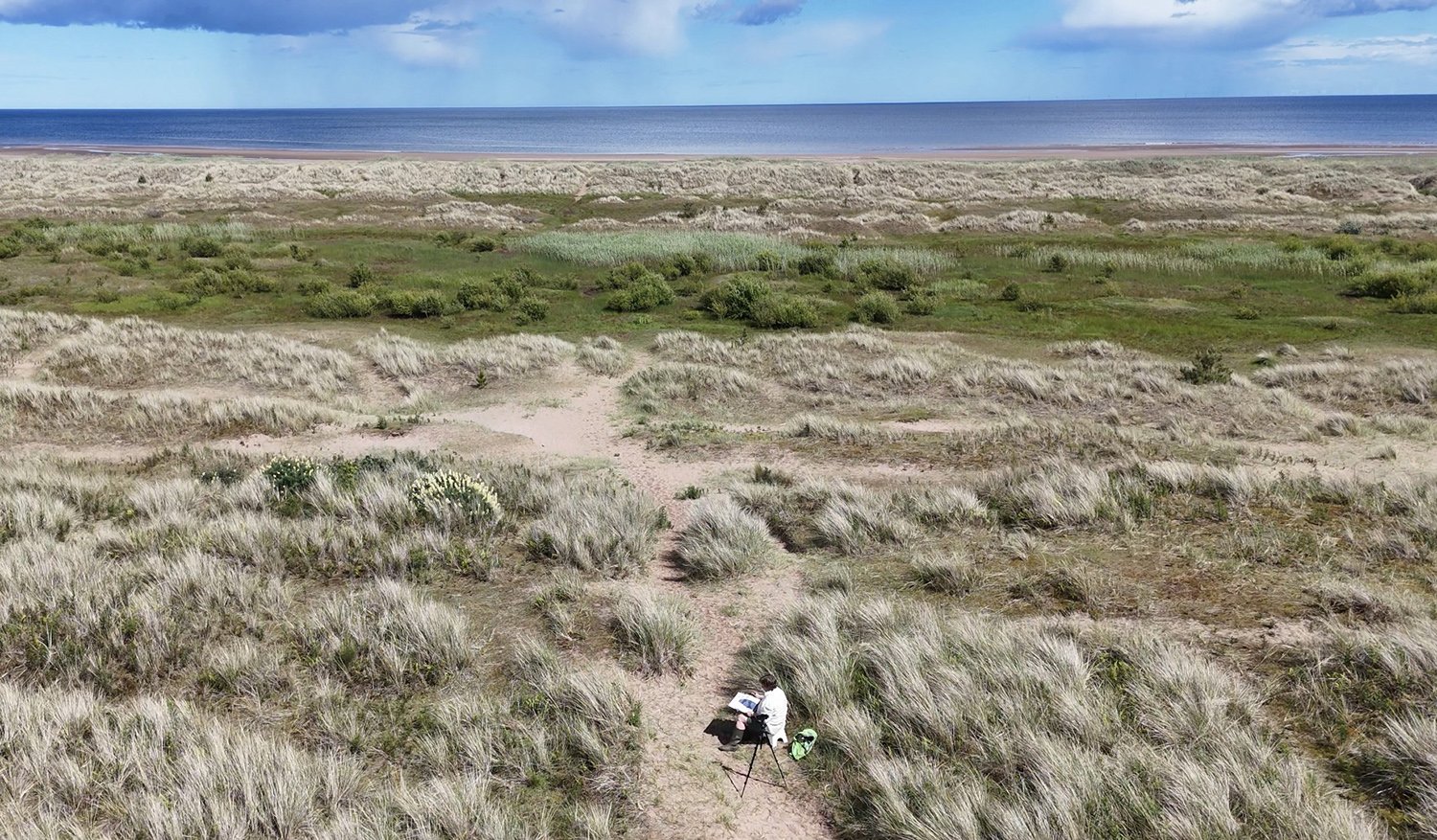
Kate Downie at Tentsmuir
Kate Downie’s Grasslands, at The Scottish Gallery, is the culmination of three years of research. “Through her detailed observation and distinctive visual language, Downie invites us to share her fascination within a body of work of remarkable complexity, beauty and significance,” The Gallery tells us. Downie has long been drawn to what she calls the “undrawable” – places and landscapes that have slipped from our collective consciousness – and in grass she has found an unusually fertile subject. There is a long art-historical lineage here, too: the artist has spoken of her enduring fascination with Dürer’s Great Piece of Turf – a work that elevated an apparently ordinary collection of vegetation into something worthy of sustained attention. Here, Downie’s gaze moves from the margins of fields and moorlands to the edges of Scotland’s coasts, tracing a feature of the landscape we so often take for granted – precisely because it is everywhere.
“Downie has travelled the length and breadth of the country in pursuit of her subject. Her focus ranges from the cliff-top tufts of Shetland, where grasses cling to nooks and crannies buffeted by the Atlantic storms, to the vast reed beds of Errol on the Tay and the rolling machair of Tentsmuir on the edge of Fife. In these artworks she captures the elemental forces at play and the ways in which grass adapts to its environment, often largely unchanged for centuries. Yet her analysis extends beyond the wild and remote. From roadside verges to the carefully manicured pitch of Hampden Park, Downie presents the full spectrum of grass habitats, revealing them as participants in a shared story of adaptation, resilience and interconnectedness. Across Scotland’s varied terrains, grass becomes both subject and witness, recording the forces that shape the landscape.”
—Tommy Zyw
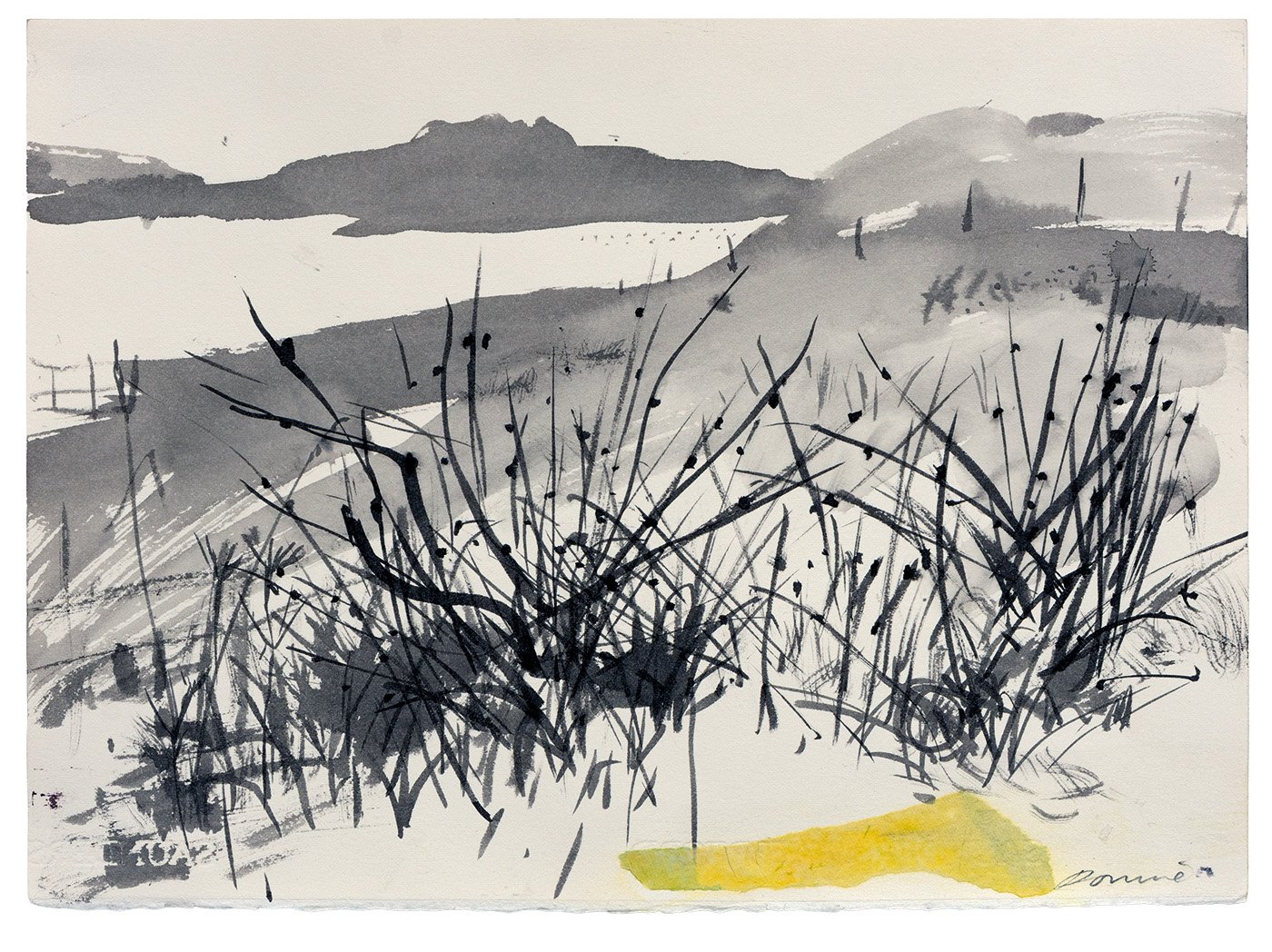
Bog Rushes, Shetland
These works act as case studies – springboards for wider discussion. Around half of Shetland is covered by peatland, from which rushes emerge as part of a wider wetland ecosystem that stores vast quantities of carbon in its waterlogged soils. Peatlands also hold and regulate water, support specialised plants and wildlife, and help protect the landscape from flooding and erosion. However, when they dry out or are damaged, they can release that stored carbon. That vulnerability is increasingly tangible in Scotland: in July 2026, a major wildfire spread through the Cairngorms National Park; firefighters battled deep-seated fires within peatland, with hotspots continuing to require dampening into August.

Salt Marsh
Here we are presented with one of the planet’s great coastal protectors. Saltmarshes capture and store extraordinary amounts of carbon in their soils and sediments, in some cases storing more carbon per hectare than forests. Their vegetation absorbs and slows floodwaters, helps hold coastlines together and provides rich nurseries for wildlife.
Downie’s exhibition will leave you with a new appreciation for grass, and all this is to say nothing of the varied media the artist has employed with such confident expression. Her love for her subject is obvious, matching material to movement: ink, watercolour, gouache, pencil, pastel, oil, cyanotype, monoprint, lithography, collage.
Not one of the environments she depicts is passive – these are protective, regenerative ecosystems performing some of the most valuable work on the planet, tirelessly responding to the landscapes around them. These are the “brave calligraphic grasses” Downie writes of: rooted in waterlogged soil, bending into the wind, clinging to exposed ground at the edge of the sea.
We need grass. Life needs grass. And yet the grasslands we depend upon are themselves increasingly vulnerable to the conditions we are creating. In Scotland, just ~65% of assessed grassland features were in “favourable condition” in 2026. At the same time, our climate is becoming warmer and drier in summer, and wetter in winter, placing increasing pressure on the landscapes we depend upon.
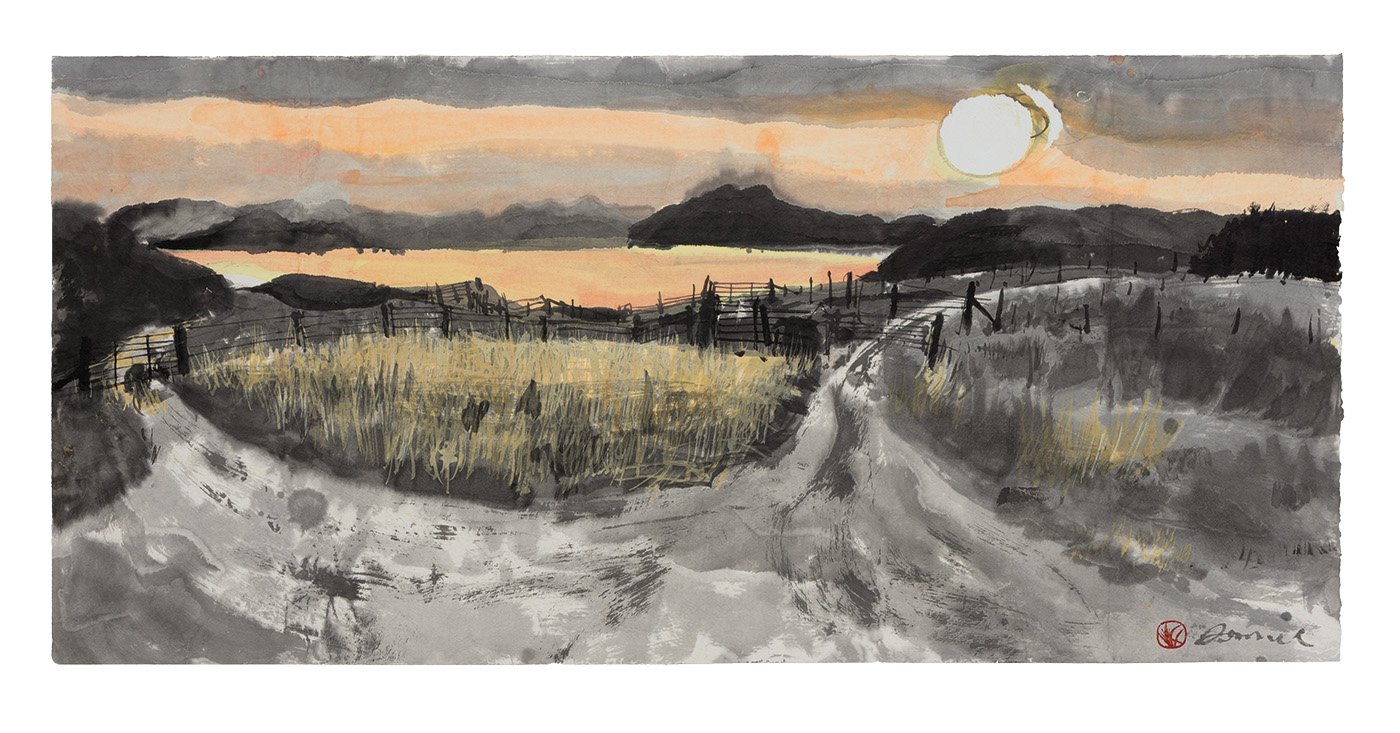
Rush Grass of Brindister Voe
ink and watercolour on xuan paper, 53 x 113cm
photograph: Michael Wolchover
At the Royal Botanic Garden Edinburgh, we find another interpretation of Grasslands, and perhaps the most fitting way to connect Downie’s show with the Botanics’ is to walk. On the 20th August, Downie led an Urban ArtMove from The Scottish Gallery to the Botanics, inviting participants to observe how grass finds its way through the city – from between worn stone steps, to an old railway bank at Cannonmills, where eight species were discovered growing together. That journey turned the city itself into a part of the exhibitions.
Grasslands at the Botanics looks further afield, revealing grassy ecosystems spanning every continent except Antarctica; forming vast, vibrant landscapes that sustain an extraordinary diversity of life, from pollinating bees to grazing elephants – to us. The exhibition draws on the Botanics’ own global research, bringing together photography, craft and illustration.
Kate Downie’s exhibition continues until Saturday 29th August 2026, and the Royal Botanic Garden’s Grasslands closes on 10th January 2027 in the John Hope Gateway Gallery.
Artwork © Kate Downie | Photogrpahy by Michael Wolchover courtesy of The Scottish Gallery | Text by A La Luz & The Scottish Gallery | Please do not re-publish any of the above without prior written consent