Carbon Derrocacy | Felipe de Ávila Franco
There is a growing sense that the structures sustaining contemporary life no longer operate through visibility, but through concealment. What circulates – whether energy, information or matter – rarely appears in its totality. Instead, it manifests in fragments, in residues, in surfaces that both reveal and obscure the systems they belong to. In this landscape, power is not only exercised through control over resources, but through the ability to render operations opaque. Felipe de Ávila Franco’s latest exhibition, Carbon Derrocacy, enters this terrain by exposing the traces that remain visible: the symptoms of our present systems.
Vessels Barricade | exhibition installation views | Anna Autio
Borrowing from the entanglement between carbon-based economies and political structures, the exhibition considers how fossil-derived systems continue to shape not only infrastructures and territories, but also perception itself. Rather than addressing extraction as a distant or isolated phenomenon, the works trace its extended presence, showing how it persists through industrial chains, technological apparatuses and the images that mediate our understanding of them.
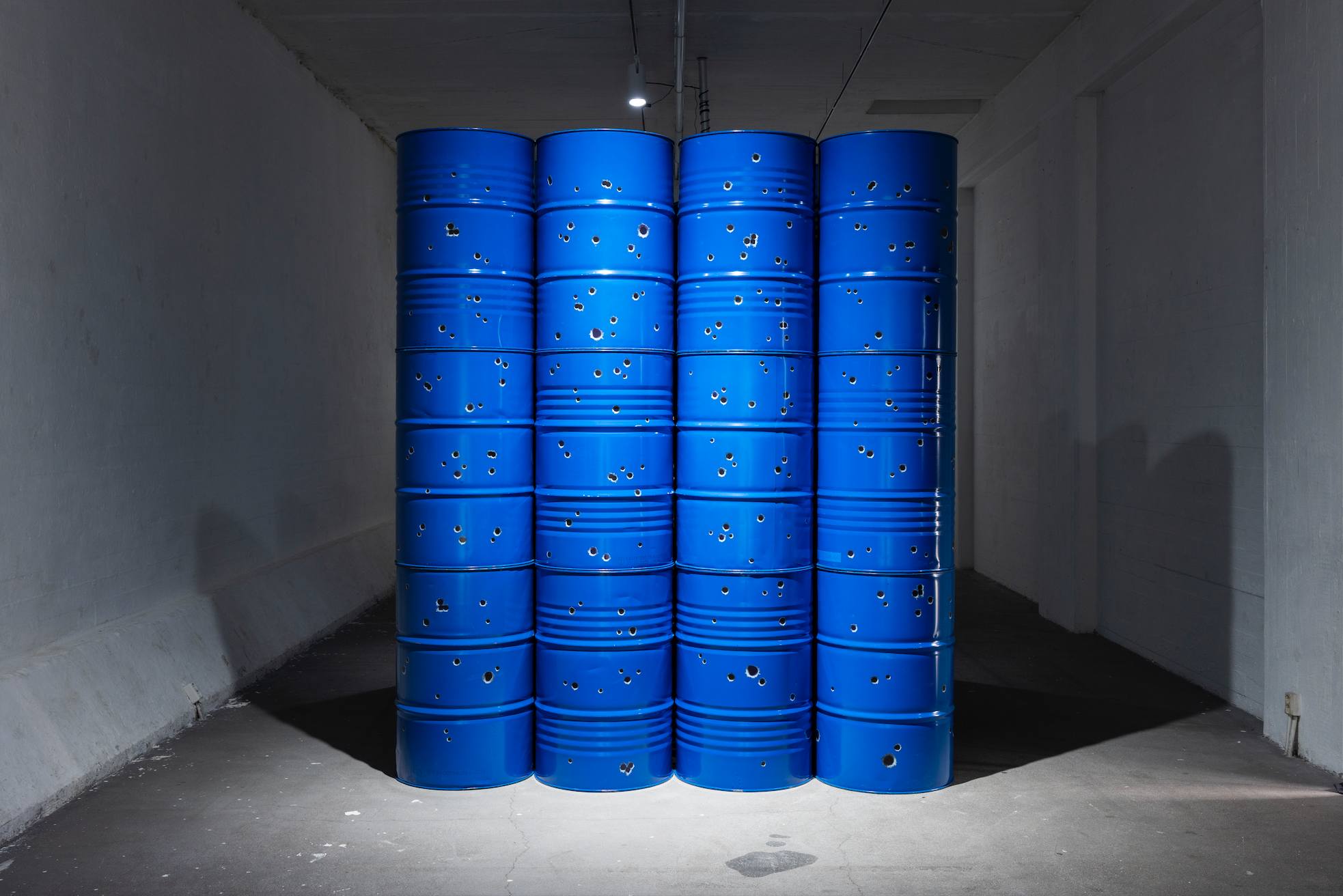
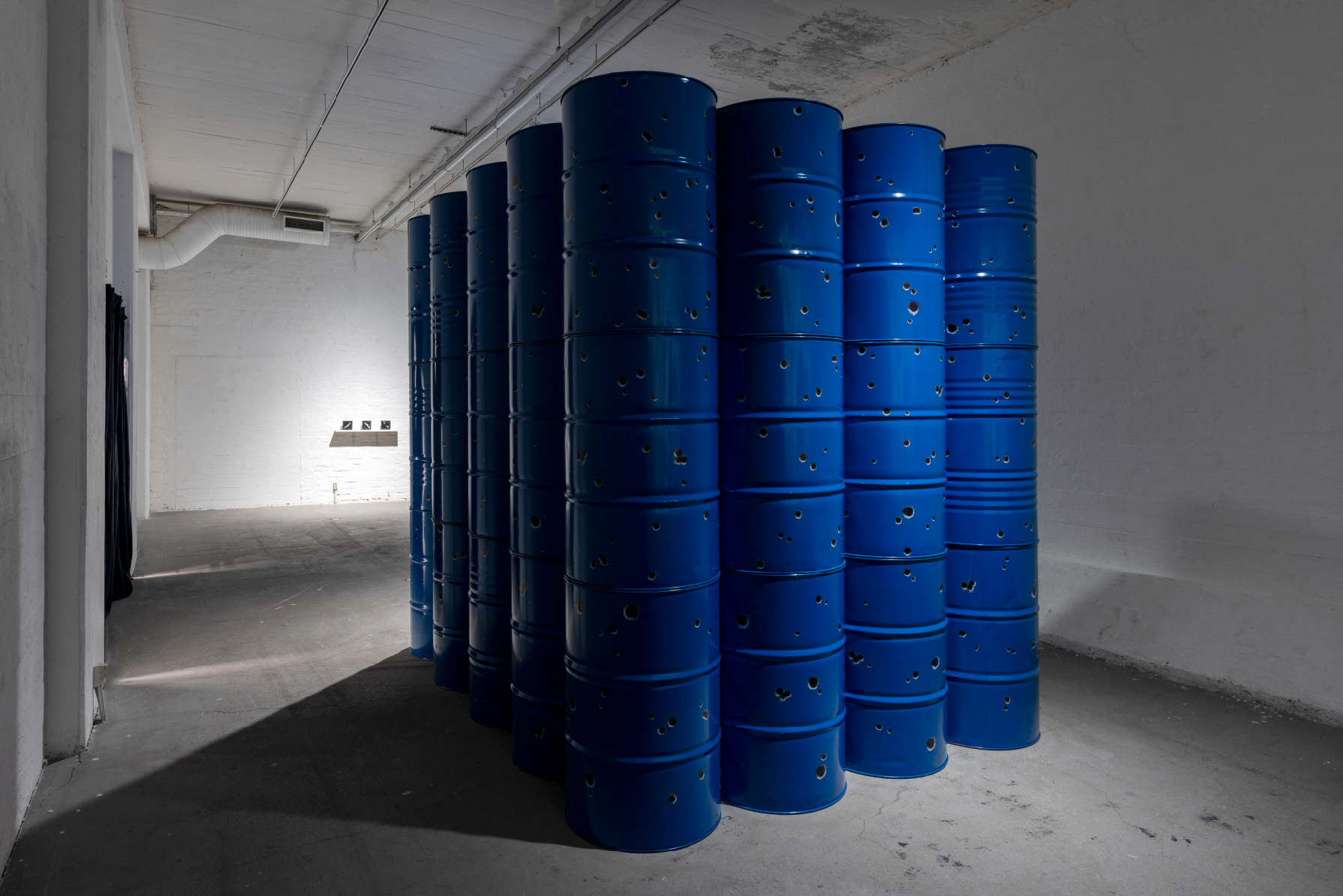
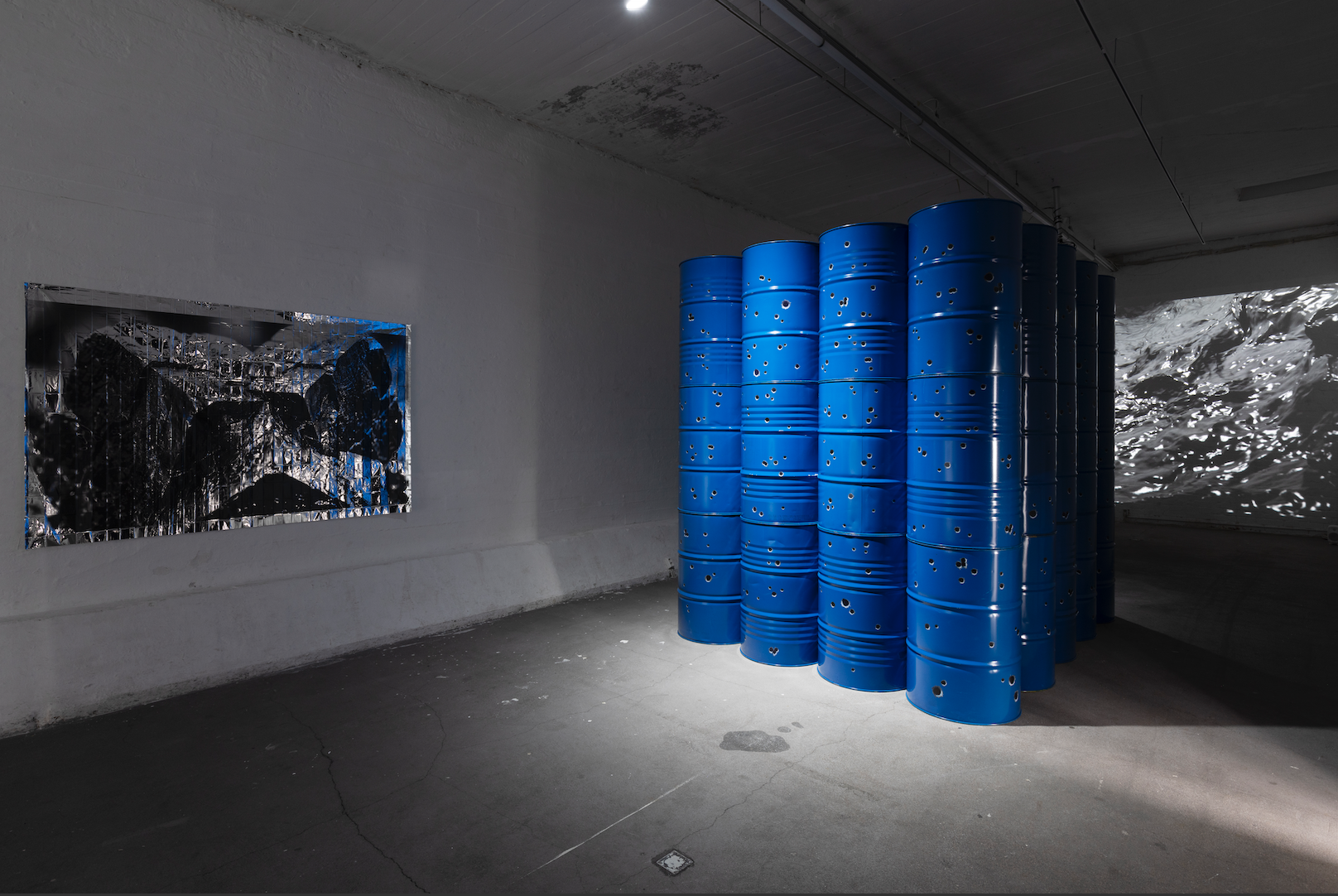
At the centre of the exhibition, Vessels Barricade constructs a spatial interruption. Composed of forty-eight industrial oil barrels arranged into a cubic formation, the structure evokes both order and containment. The barrels, standardised and coded in blue, suggest systems of circulation and global logistics. Yet their accumulation produces a mass that resists passage. The form oscillates between architecture and obstruction, between storage and defence.
Across their surfaces, marks resembling bullet impacts appear, yet they are not the result of actual force. These traces, applied as images, operate within the ambiguous space between representation and event. They allude to a state of permanent imminence, where conflict does not need to fully materialise to exert its effects. The work reflects a condition in which geopolitical tensions are continuously staged, mediated and absorbed, producing real consequences through mechanisms of anticipation, fear and uncertainty. The barrels become bodies, targets, containers and barriers simultaneously, holding, deflecting and concealing the flows they were designed to transport.
While Vessels Barricade addresses the visible architectures of extraction, Cold Bodies shifts attention to its less perceptible transformations. Emergency thermal blankets, typically used to preserve body heat in critical situations, are repurposed as reflective supports for UV-printed images. Their surfaces, unstable and reactive to light, resist fixed visibility. What appears is always partial and contingent on the viewer’s position.
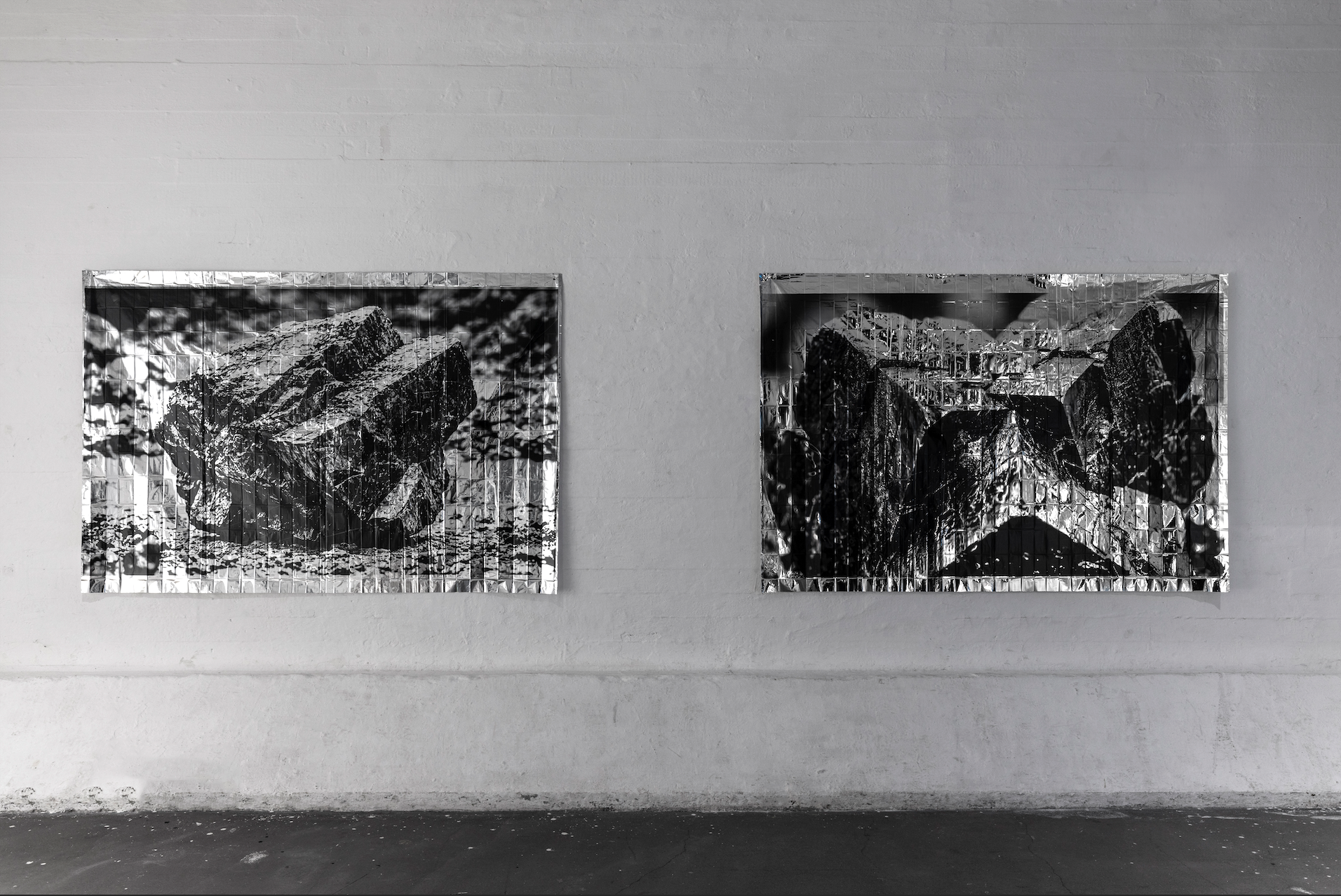
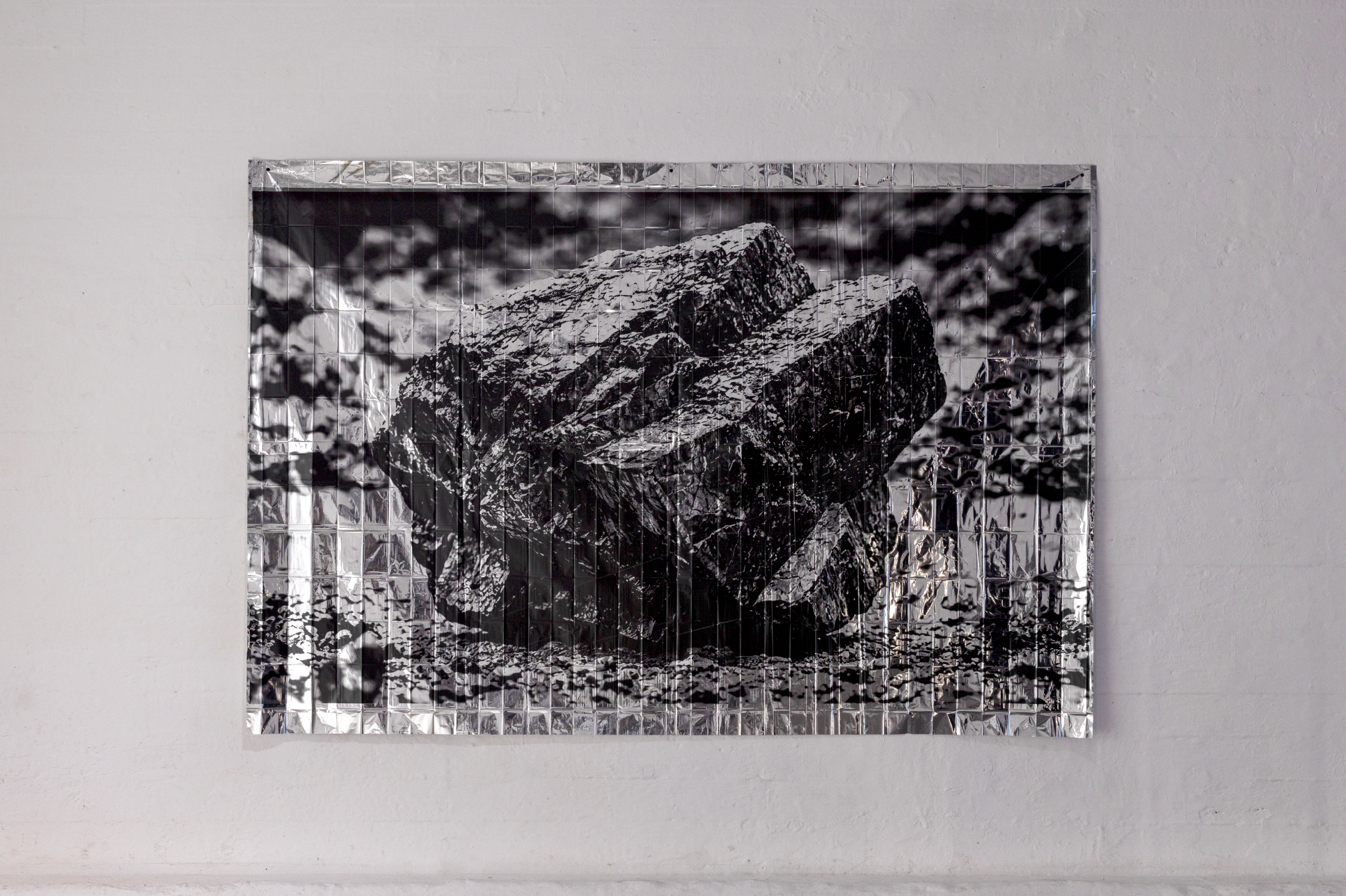
Cold Bodies | exhibition installation views | Anna Autio
The images themselves depict mineral forms such as coal, metallic ores and speculative representations of rare earth elements, generated through artificial intelligence systems. These visual constructs do not document extraction sites, but instead simulate the raw materials that sustain contemporary technological infrastructures. Beneath their surface lies a more extensive chain: petroleum refinement yields sulphur, sulphur becomes sulphuric acid, this acid enables the extraction of copper and cobalt, and these metals sustain the electrical and computational architectures that define the present.
Within this sequence, energy does not disappear. It transforms, migrates, and accumulates across different states. The blankets, once designed to protect vulnerable bodies, now reflect another form of exposure, the dependency of digital systems on heavy industrial processes. The coldness suggested in the work resonates not only with the material but with the infrastructures it points to, including data centres, computational systems and the abstraction of labor and matter that sustains them. What appears immaterial is grounded in extraction and what seems distant is structurally immediate.
The video work Leaks extends this logic into the realm of the impossible. A continuous projection presents a synthetic image of oil and seawater fully merging into a single substance, an event that cannot occur under natural conditions. Developed through iterative simulations and approximations of physical properties, the image attempts to reconcile two materials defined by their incompatibility.
The familiar expression “like oil and water” is here suspended. Instead of separation, there is cohesion. Instead of resistance, a seamless surface. Yet this unity remains artificial, a constructed illusion that underscores the limits of reconciliation. The work reflects on systems that are fundamentally irreconcilable, such as ecological preservation and extractive economies, but are nonetheless forced into coexistence. What emerges is not harmony, but a fragile and unstable continuity sustained through technological mediation.
Across the exhibition, materials and images operate as carriers of displacement. They do not simply investigate processes of extraction and transformation, they embody them. Industrial residues, algorithmic images and constructed forms intersect to reveal a condition in which the boundaries between natural and artificial, organic and mechanical become increasingly indistinct. What is at stake is not only the environment as an external entity, but the ways in which bodies, territories and systems are co-implicated within these transformations.
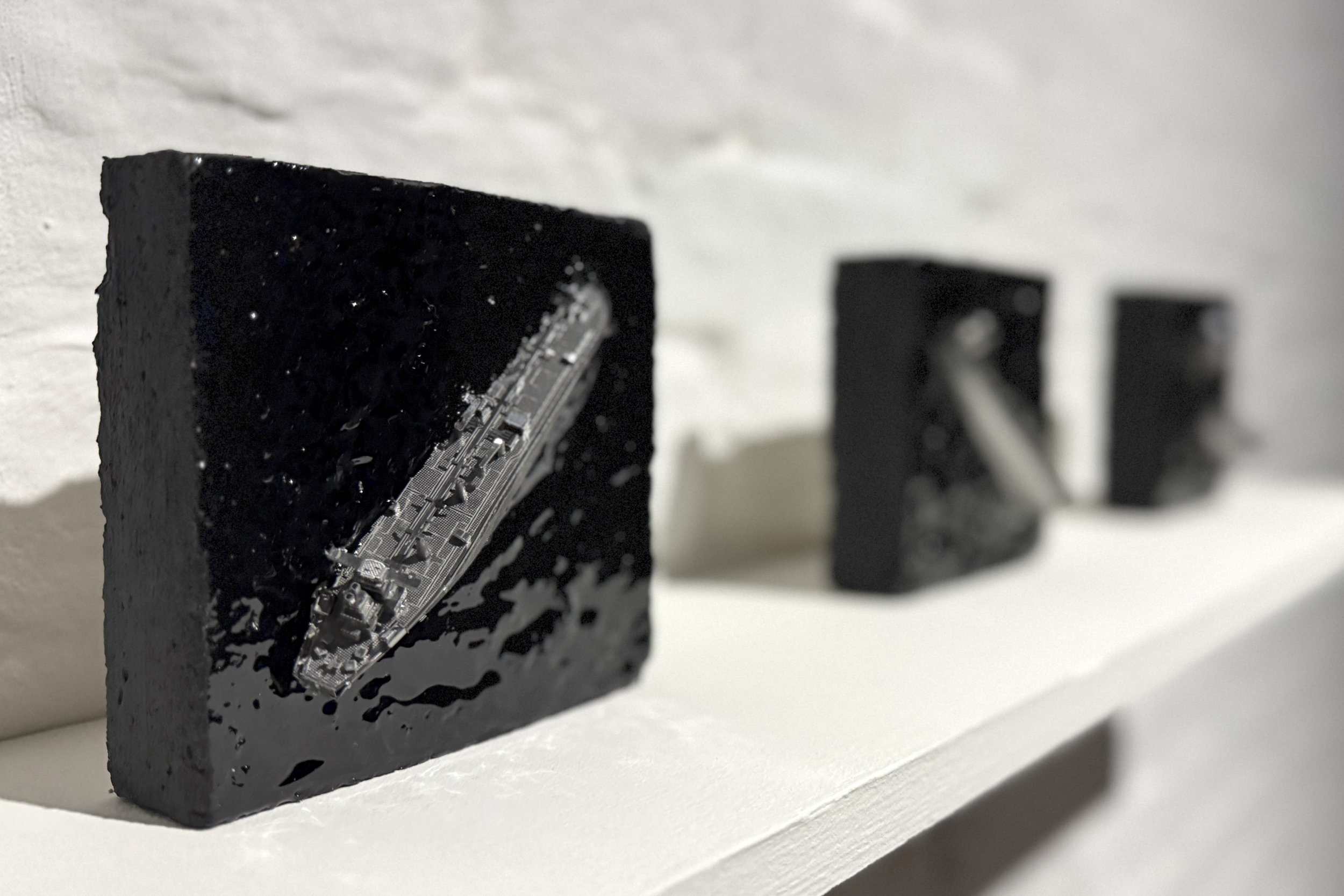
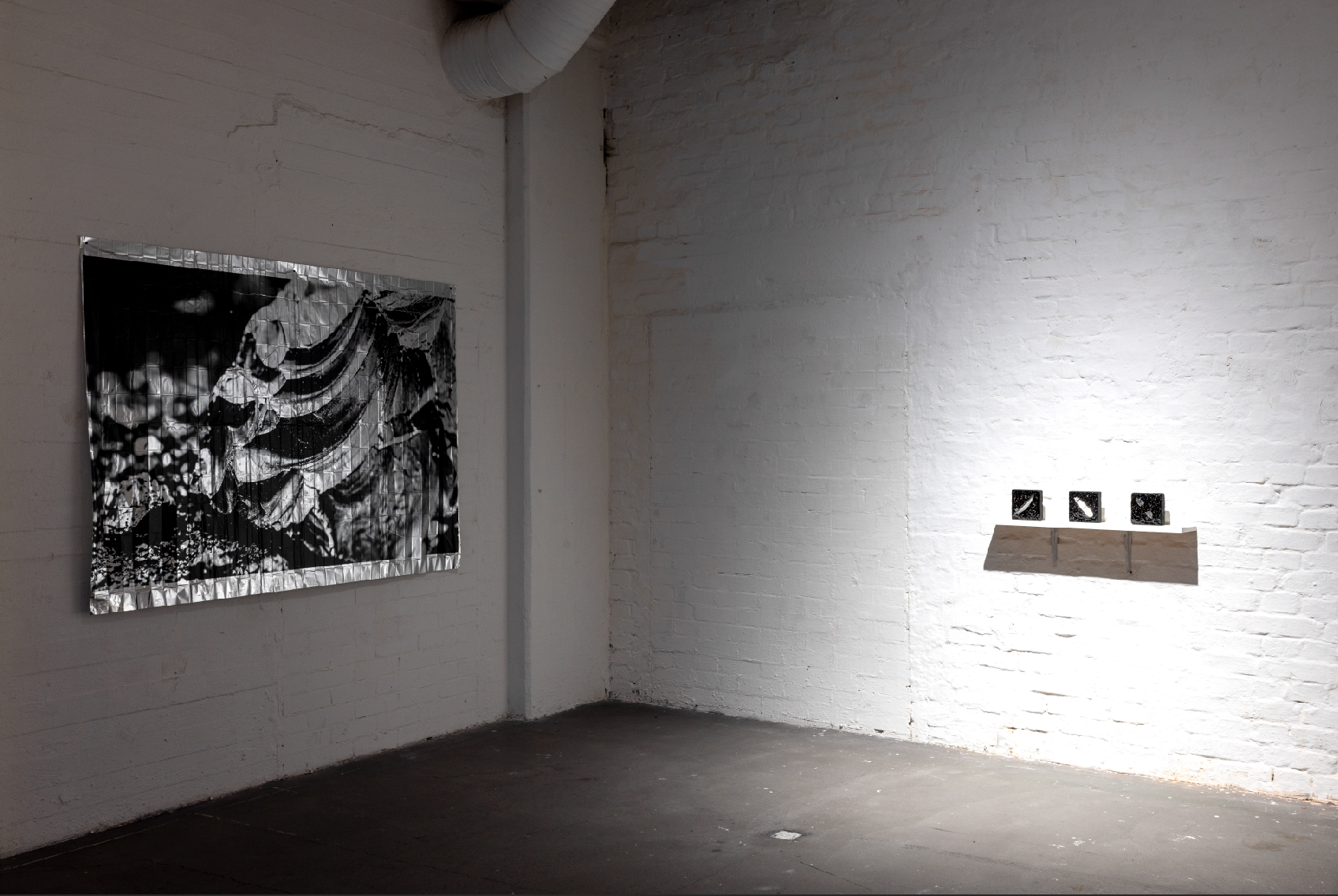
Exhibition installation views | Anna Autio & Felipe de Ávila Franco
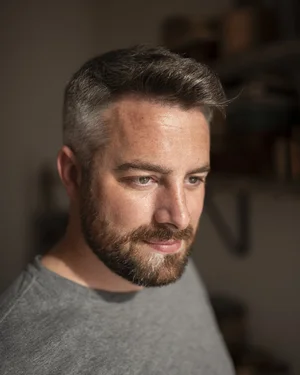
Felipe de Ávila Franco (b. 1982, Brazil) has developed a practice that moves between sculpture, installation, and image-making, engaging with questions of materiality, energy, and environmental aesthetics. Working across South America and Europe, his research investigates the intersections between industrial processes, technological systems, and the socio-political conditions they produce. Through the use of both traditional and experimental techniques, his works incorporate industrial materials and residues, reconfiguring them into forms that reflect on extraction, infrastructure, and the human body as a site of entanglement.
His work has been exhibited internationally and is part of collections including the Museum of Brazilian Art FAAP in São Paulo, the Helsinki Art Museum (HAM), and the Museum of Contemporary Art Kiasma in Helsinki. Across these contexts, his practice continues to examine how contemporary sculpture can operate as a means to materialise complex temporalities, where geological, technological, and human scales converge, often in states of tension, instability, and irreversible transformation.
The realisation of this exhibition at Forum Box in Helsinki (which ran until 24th May 2026) was supported by Suomen Kulttuurirahasto and the Arts Promotion Centre Finland TAIKE. Special thanks for the collaboration and support of Paketo Oy.
Images used with permission | Text by Felipe de Ávila Franco | Please do not re-publish any of the above without prior written consent